
RESOURCE / OPTICAL SENSING
Raman polaritonics
Infrared sensitivity. Visible-light readout.
How silicon carbide (SiC) nanostructures connect the infrared response of nearby materials to a visible-light Raman measurement.
Published by Tiny Infinities · 24 September 2026
Updated 25 September 2026
What does Raman polaritonics measure?
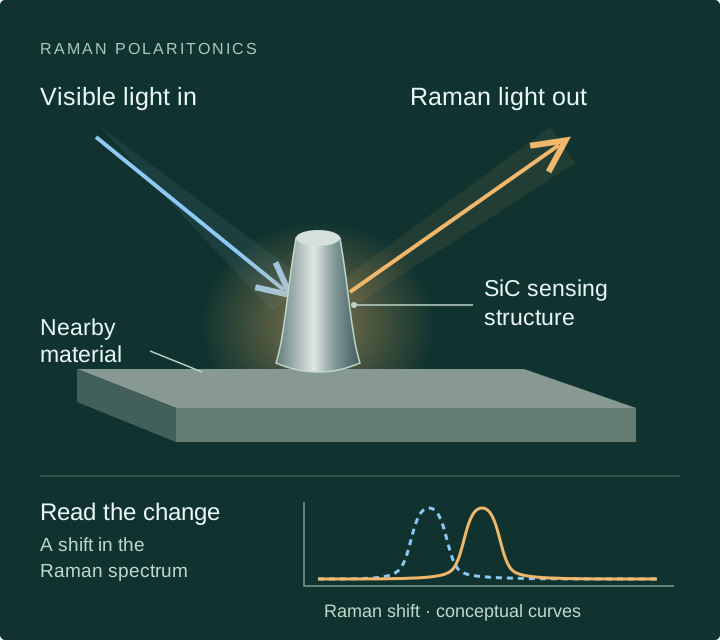
Raman polaritonics uses Raman scattering to study coupled lattice vibrations and electromagnetic fields. In the sensing approach discussed here, a SiC nanostructure acts as an optical resonator. Changes in its Raman spectrum can reveal changes in the material surrounding it.
The measured result is a spectrum. Connecting it to a property such as film thickness requires a calibrated relationship for the structure, material and measurement conditions.
What is a surface phonon polariton?
A phonon is a quantum of lattice vibration. In a polar crystal such as SiC, certain vibrations can couple to an electromagnetic field, forming a phonon polariton. Surface phonon polaritons are associated with an interface; their fields extend into the surrounding material and decay away from it.
Suitable nanostructures can localise these modes on a scale smaller than the infrared wavelength. The review by Caldwell and colleagues explains the physical background.
How can visible light read an infrared response?
In Raman scattering, light exchanges energy with an excitation in a material. A spectrometer measures the difference between incident and scattered light as a Raman shift.
Both the incident and scattered light can be visible while their energy difference corresponds to an infrared-frequency excitation. Visible-light readout therefore does not mean that the sensing resonance is in the visible range.
Caldwell and colleagues’ SiC resonator study demonstrated Raman readout of suitable localised surface phonon polariton modes. Here the useful signal comes from the sensing structure’s response to its surroundings.
Why do shape and surroundings matter?
The resonator’s shape affects which modes it supports. Its field overlaps nearby material, whose dielectric response—its response to an electromagnetic field—can shift a resonance.
The relevant material response is frequency dependent. A visible-light refractive index alone does not describe the infrared response. Geometry, distance and coverage must also be controlled when interpreting a spectral change.
What has the research shown?
Our team’s 2026 preprint reports experiments on SiC nanostructures fabricated on a SiC substrate. These included pillars surrounded by liquids and structures coated directly with thin alumina layers. Raman features changed with structure and environment.
The coating experiment reached a saturated response, limiting the range over which thickness could be inferred. The study also found differences between Raman and infrared spectra: the Raman readout is not a complete infrared absorption spectrum.
Why is this relevant to thin films?
These results motivate research into thin-film sensing. A useful thickness measurement would need a defined film and substrate, a calibrated response range and comparison with an independent reference method. Repeatability and uncertainty must be established for the intended use.
PolarTip is our AFM probe line. PolarSense is a future sensing direction, with thin films as its first application focus. The two draw on shared SiC fabrication expertise, but an AFM tip radius does not establish optical spatial resolution. Read more about our optical research.
Research behind the approach
Zograf and colleagues, Raman scattering of phonon polaritons under nanoscale confinement: the role of structure and environment. 2026 preprint, version 1. Co-authored by Tiny Infinities team members Betül Küçüköz and Timur Shegai.
Discuss a thin-film measurement
Tell us about the film, substrate, property of interest and the limitation of your current method. These details help define a useful research question.